Head layout: roller, pad or both
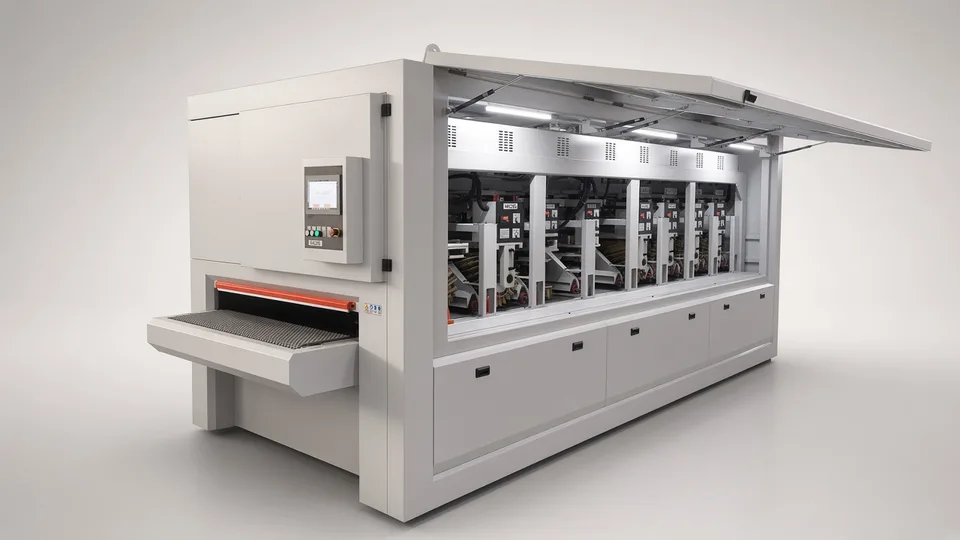
A steel contact roller removes stock and calibrates thickness. A pad, or platen, presses the belt flat for a fine finish on veneer. Combination heads switch between them. Match the layout to your job.
 No Drama
Buyer guide · Woodworking
Two wide belt sanders of the same width can do different jobs, one calibrating boards to thickness and one finishing veneer, and the head layout that decides which is often hidden in a short code in the listing title.
01
A steel contact roller removes stock and calibrates thickness. A pad, or platen, presses the belt flat for a fine finish on veneer. Combination heads switch between them. Match the layout to your job.
Width sets the widest panel. Belt length affects belt life and cooling. Ask belt size so you can price belts locally.
Calibrating heads need the most power. Ask the rating of each head, not only the total.
The conveyor belt and pressure rollers hold the panel. Ask the thickness reading method and the feed speed range.
The belt must oscillate sideways and track evenly or it scores the panel. Ask whether tracking is by air sensor or by photocell.
02
Listing titles use a layout code: R for a contact roller head, P for a pad head, RP for a combination head, followed by working width in millimetres. Confirm on the drawing, the letters are a habit, not a standard.
03
Send these with the enquiry. Without them, any number a factory gives you is a guess dressed as a quotation.
04
| Require this | A pass looks like |
|---|---|
| Calibrate your roughest board, then measure thickness at the corners and centre. | Every reading within your thickness tolerance across the full width. |
| Sand a veneered panel with the pad head at your finishing grit. | No sand-through at the edges and no chatter marks you can see under a raking light. |
| Feed your shortest panel. | It passes under all heads without stalling or rounding the leading edge. |
05
06
A thicknessing planer, which removes stock faster and costs less in belts.
A profile or brush sander; a flat wide belt only sands flat faces.
07
We name the kind of source, how many and when, and never the factory. Listed prices are asking prices, not landed cost. Where we do not hold a fact we say so: that is a GAP, not an estimate.
08
Every machine we source in this area is on the Woodworking page. How a project runs, stage by stage, is on how it works, and what it costs is on pricing.
Straight answers
Belt tracking, pad construction and thickness accuracy. Run the same calibrating and veneer tests on both.
A corner and centre thickness check, a veneer panel without sand-through, the shortest panel, tracking, emergency stops and extraction data.
A Declaration of Conformity naming your serial number, instructions in your language with extraction data, and a technical file kept by the manufacturer.
The business placing it on the EU market, usually the buyer. It adds its name and checks the documents. Hardwood dust control is the employer's duty under 2004/37/EC.
Contact
Send a machine, a quotation you want checked, or a question. We reply with what we would look at first.
Sent
A person reads every message. You will hear back within one working day.
Not sent
Please email info@nodramachina.com directly and we will pick it up from there.