Laser tube and its life
Fabric lasers are almost all CO2. Glass tubes are cheap and wear out; metal RF tubes cost more and last longer. Ask the tube type, its rated hours and its replacement price.
 No Drama
Buyer guide · Textile & garment
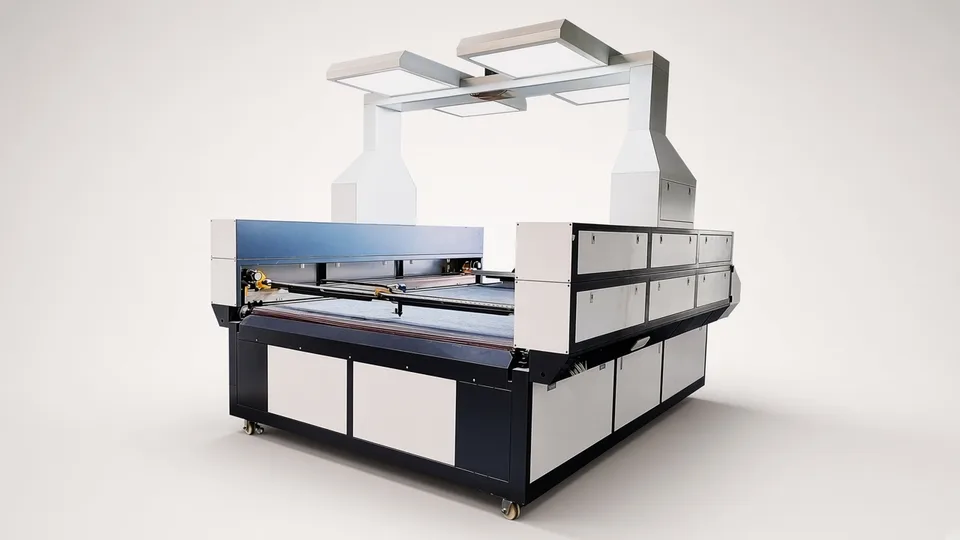
A fabric laser cutting machine is bought on wattage and bed size, but the fabric decides the result: synthetics melt into a sealed edge, natural fibres scorch, and the fumes from both are a workplace problem the quote rarely prices.
01
Fabric lasers are almost all CO2. Glass tubes are cheap and wear out; metal RF tubes cost more and last longer. Ask the tube type, its rated hours and its replacement price.
A conveyor bed with an auto feeder cuts from the roll without stopping. A static bed needs sheets laid by hand. For production the feeder matters more than the wattage.
A camera reads printed outlines so sublimated sportswear and patches cut on the print. Ask how it handles fabric that shifts after printing.
Two heads on one gantry double throughput only on repeated parts. Ask for the motion system and drive brand.
Burning synthetics gives smoke and residue. Ask for the extractor airflow and whether filtration is in the price.
02
Send these with the enquiry. Without them, any number a factory gives you is a guess dressed as a quotation.
03
| Require this | A pass looks like |
|---|---|
| Cut your pattern from each of your fabrics, synthetic and natural, at production speed. | Synthetic edges sealed without hard beads, natural edges without scorch beyond what you accept, sizes inside tolerance. |
| Cut printed fabric with the camera on a full roll length. | Cut line stays on the printed outline within your tolerance from first to last piece. |
| Run the extractor during the cut and inspect the room and lens. | No visible smoke escaping the enclosure and no residue on the lens after the run. |
04
05
An automatic fabric cutting machine with a knife, which cuts many plies and leaves no scorch.
A laser marking or engraving machine, which is a different product with different optics.
06
We name the kind of source, how many and when, and never the factory. Listed prices are asking prices, not landed cost. Where we do not hold a fact we say so: that is a GAP, not an estimate.
07
Every machine we source in this area is on the Textile & garment page. How a project runs, stage by stage, is on how it works, and what it costs is on pricing.
Straight answers
Tube type and life, motion system, camera software and service. Ask every supplier, European or Chinese, for the tube, drive and controller brands, and compare the parts lists line by line.
Laser class label, interlocks on every door, extractor running, tube type and hours, and a cut test on each of your fabrics.
A Declaration of Conformity, laser safety documentation to EN 60825-1 and the technical file. A CE sticker alone proves nothing.
The company placing it on the EU market, which is you when buying direct. You check the conformity file and put your name on the machine or papers.
Contact
Send a machine, a quotation you want checked, or a question. We reply with what we would look at first.
Sent
A person reads every message. You will hear back within one working day.
Not sent
Please email info@nodramachina.com directly and we will pick it up from there.