Bed size against your largest sheet
Board suppliers sell sheets that a 2513 bed takes whole. A smaller bed means cutting sheets first or printing in tiles. Measure your largest job before you read any price.
 No Drama
Buyer guide · Printing & signage
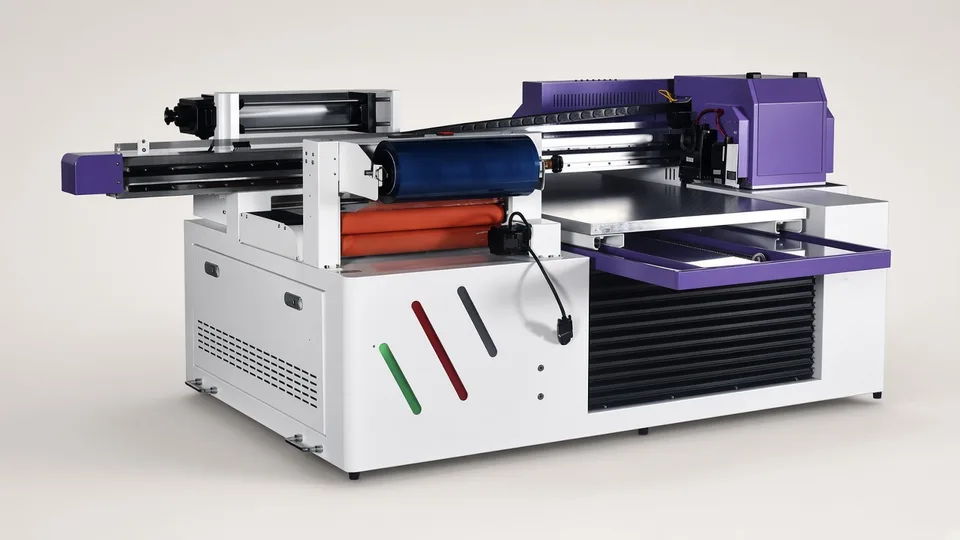
A UV flatbed printer is sold by its bed size, and the step from a desk unit to a full sheet bed multiplies the price several times and changes the vacuum table, the gantry and the heads, so buyers end up comparing machines of different classes.
01
Board suppliers sell sheets that a 2513 bed takes whole. A smaller bed means cutting sheets first or printing in tiles. Measure your largest job before you read any price.
Large beds hold rigid boards with suction. Zoned vacuum lets you print a small item without covering the rest of the table. Ask how many zones, and the pump power.
Desk units carry one or two small heads; sheet beds carry industrial heads, often several. Ask the maximum object height the gantry clears, which decides whether you can print boxes, doors or bottles on a rotary.
A camera that locates small items on the bed saves making jigs for promotional goods. Ask whether it is standard and whether it works with your RIP.
On a large bed, a steel frame and linear guides keep the gantry square across the full width. Ask frame weight and guide make, and check banding at both ends of the bed.
02
Most listings name the bed in centimetres or tenths of a metre: the first pair of digits is one side, the second pair the other.
03
Send these with the enquiry. Without them, any number a factory gives you is a guess dressed as a quotation.
04
| Require this | A pass looks like |
|---|---|
| Print your file across a full sheet of your board, with fine text at all four corners. | No banding or skew between corners; text sharp at both ends of the gantry. |
| Cross-cut adhesion test to ISO 2409 on your two hardest materials, glass and a coated metal. | Classification 0 or 1 on both after the stated curing time. |
| Print varnish over colour on a small item placed by the camera. | Varnish sits on the colour with no visible offset at the edges. |
05
06
A large format printer or an eco solvent printer; a flatbed wastes its bed on flexible media.
A UV DTF printer, which makes transfers you apply by hand to any shape.
07
We name the kind of source, how many and when, and never the factory. Listed prices are asking prices, not landed cost. Where we do not hold a fact we say so: that is a GAP, not an estimate.
08
Every machine we source in this area is on the Printing & signage page. How a project runs, stage by stage, is on how it works, and what it costs is on pricing.
Straight answers
In large beds it is often the head make, the frame and the service contract. Compare those three on paper before comparing prices.
A full-sheet print, adhesion on your materials, vacuum hold on a warped board, gantry clearance, head serials and the lamp hour meter.
A declaration under machinery law plus low voltage and EMC, lamp exposure data, and a manual in your language.
The business that first places the printer on the EU market, usually you when buying direct.
Contact
Send a machine, a quotation you want checked, or a question. We reply with what we would look at first.
Sent
A person reads every message. You will hear back within one working day.
Not sent
Please email info@nodramachina.com directly and we will pick it up from there.