Robot type: articulated, column or gantry
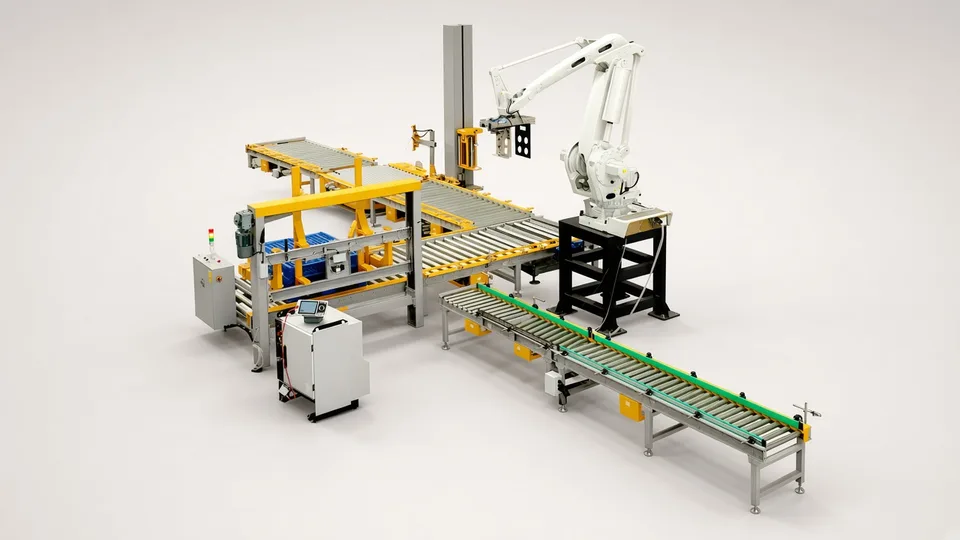
A four-axis articulated palletizing robot, a lower-cost column machine or a low-level gantry. They differ in reach, speed, footprint and how many pallet stations one robot can serve.
 No Drama
Buyer guide · Material handling
A robotic palletizer is sold on payload and a cycles per hour figure, but your throughput is cycles times cases per pick, measured with your heaviest case, your pattern and the slowest corner of the stack, and a headline cycle rate taken empty says nothing about that.
01
A four-axis articulated palletizing robot, a lower-cost column machine or a low-level gantry. They differ in reach, speed, footprint and how many pallet stations one robot can serve.
Listings named payloads of 150 and 180 kg. The gripper, vacuum or clamp, eats part of that. Ask what remains for product at full reach, and what a two-case pick weighs.
Ask for cycles per hour with your heaviest case at the top corner of a full pallet, not an empty-arm test. Multiply by cases per pick to get your rate.
One robot can build two pallets from two lines, or one pallet while a person swaps the other. Pallet and slip sheet dispensers are often separate lines on the quote.
How new patterns and new cases are added: on the teach pendant by an engineer, or in a pattern editor by your staff. Ask for a demonstration of adding one.
02
Send these with the enquiry. Without them, any number a factory gives you is a guess dressed as a quotation.
03
| Require this | A pass looks like |
|---|---|
| Build full pallets of your heaviest case in your real pattern for a timed hour. | Cases per hour meet the quote, and every layer is square with no overhang beyond your limit. |
| Swap a full pallet while the robot builds on the other station. | The robot keeps working, and the station being serviced is protected by a safety-rated function. |
| Add a new case size and pattern with your own staff watching. | They can repeat it from the manual without the supplier. |
04
05
A conventional layer palletizer, which builds whole layers faster than an arm picks.
A collaborative arm or a lift table with a person, since a full cell will not pay back.
06
We name the kind of source, how many and when, and never the factory. Listed prices are asking prices, not landed cost. Where we do not hold a fact we say so: that is a GAP, not an estimate.
07
Every machine we source in this area is on the Material handling page. How a project runs, stage by stage, is on how it works, and what it costs is on pricing.
Straight answers
Often the robot is a known brand either way. The difference is the gripper, the safety design and the pattern software. Compare those.
A timed hour with your heaviest case, pallet squareness, the pallet swap under safety, pattern editing by your staff, and the program backup.
A Declaration of Conformity for the whole cell with its risk assessment. The robot alone arrives with a declaration of incorporation.
The company placing the cell on the EU market, often the buyer. It checks the declaration and adds its name and address.
Contact
Send a machine, a quotation you want checked, or a question. We reply with what we would look at first.
Sent
A person reads every message. You will hear back within one working day.
Not sent
Please email info@nodramachina.com directly and we will pick it up from there.