Flask and receiving flask
The evaporating flask sets batch size; the receiving flask sets how long you run before emptying. Ask whether continuous feed and discharge valves let you work without breaking vacuum.
 No Drama
Buyer guide · Lab & process
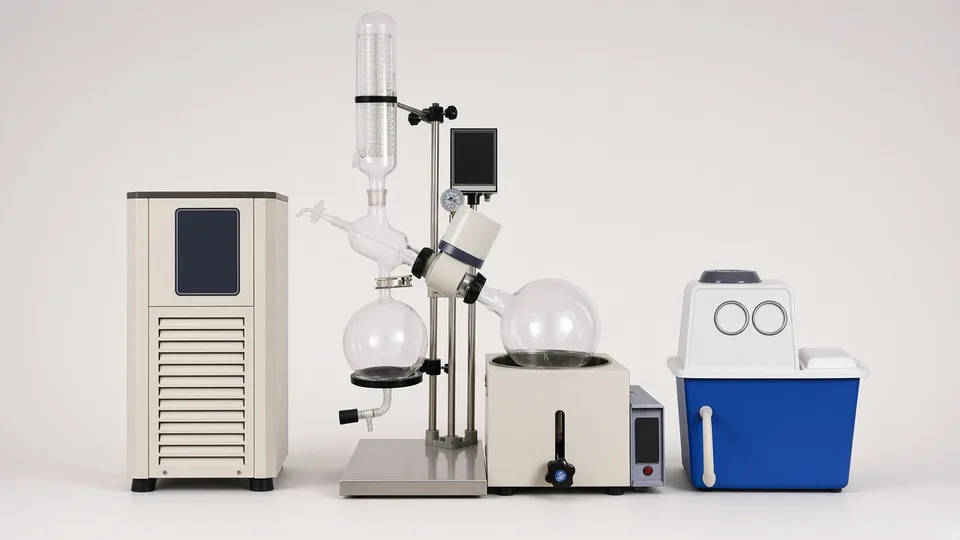
A rotary evaporator is sold by flask size, but what you buy is litres of your solvent recovered per hour, and that depends on a chiller and vacuum pump the headline price often leaves out.
01
The evaporating flask sets batch size; the receiving flask sets how long you run before emptying. Ask whether continuous feed and discharge valves let you work without breaking vacuum.
Vertical coil condensers, sometimes with an auxiliary trap, are stated in square metres. Too little area means solvent passes to the pump.
Condenser coolant temperature and cooling power decide the real rate. Ask whether a chiller is included, its capacity at the temperature you need, and its refrigerant.
PTFE diaphragm, water ring or oil pumps each behave differently with solvents. A controller that holds a set pressure stops bumping and foaming.
Standard units have ordinary motors and switches. Large flasks of ethanol or other flammable solvent raise an ATEX question for motor, bath heater and lift.
02
In a common series the last digits give the evaporating flask volume in litres, so R-1050 carries a 50 L flask. The rate is a separate line in the table, and differs by solvent.
03
Send these with the enquiry. Without them, any number a factory gives you is a guess dressed as a quotation.
04
| Require this | A pass looks like |
|---|---|
| Evaporate a measured volume of your own solvent at your bath temperature and set pressure, with the chiller and pump quoted. | Recovered litres per hour at or above the rate in the offer, measured in the receiving flask. |
| Close the system under vacuum and watch the gauge for an hour. | Pressure rise inside the leak figure stated on the spec sheet. |
| Run the rotation and lift through a full shift with a loaded flask. | Speed stays steady, seals stay tight, lift holds position without creep. |
05
06
An industrial centrifuge, which separates by density.
A falling film or other continuous evaporator sized for flow, not a batch flask.
07
We name the kind of source, how many and when, and never the factory. Listed prices are asking prices, not landed cost. Where we do not hold a fact we say so: that is a GAP, not an estimate.
08
Every machine we source in this area is on the Lab & process page. How a project runs, stage by stage, is on how it works, and what it costs is on pricing.
Straight answers
Glass quality, seals, vacuum control, condenser area and explosion protection. Compare stated rates for the same solvent with the chiller and pump named on both quotes.
Serial against the declaration, flask and condenser sizes, glass joints, seal type, vacuum hold, rotation speed, lift, and a timed run of your solvent.
A Declaration of Conformity for that serial number with a technical file behind it, under machinery, low voltage and EMC rules, and ATEX where flammable solvents are used.
The business placing it on the EU market, usually the lab or company buying direct. Your name goes on the unit or papers and you check the conformity file.
Contact
Send a machine, a quotation you want checked, or a question. We reply with what we would look at first.
Sent
A person reads every message. You will hear back within one working day.
Not sent
Please email info@nodramachina.com directly and we will pick it up from there.