Mill layout
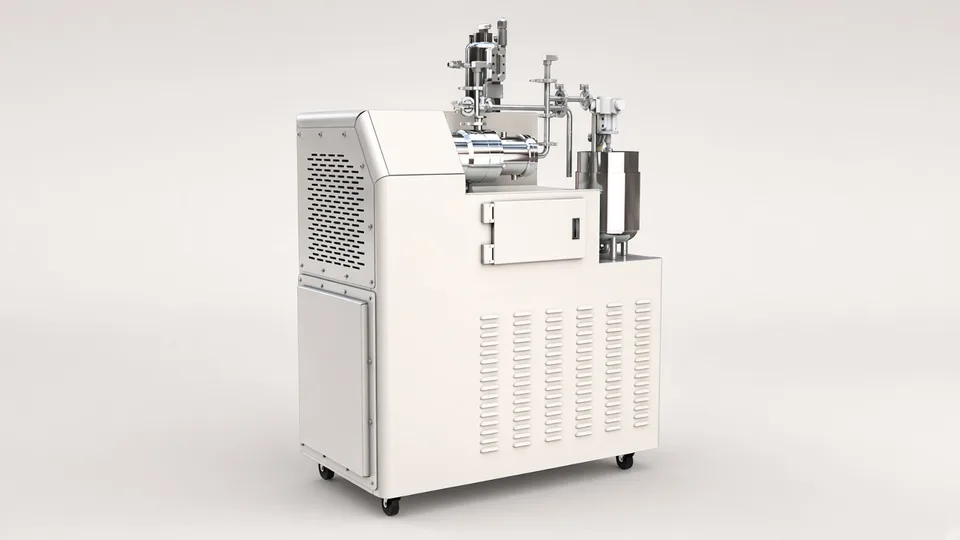
Horizontal disc, pin or turbo mills pump slurry through a closed chamber. Basket mills hang a bead cage inside your batch tank with no feed pump. Vertical mills sit between. Output and cleaning differ completely.
 No Drama
Buyer guide · Lab & process
The finest particle a bead mill can reach is set by the smallest bead its separator will hold back, and the chamber liner decides which metal ends up in your slurry, yet most quotes state neither.
01
Horizontal disc, pin or turbo mills pump slurry through a closed chamber. Basket mills hang a bead cage inside your batch tank with no feed pump. Vertical mills sit between. Output and cleaning differ completely.
A slotted screen or a dynamic gap keeps beads in. Ask for the gap width and the smallest bead it retains. A mill that holds only coarse beads cannot reach sub-micron sizes, whatever the brochure says.
Hardened steel, zirconia, silicon carbide or polyurethane. Metal parts wear into light pigments and battery slurries. Match liner, rotor and bead material to what your product may contain.
A double mechanical seal with flushing liquid is normal for solvent work. Grinding energy becomes heat, so ask for jacket area and required cooling water flow.
Solvent inks and coatings raise an ATEX question for the motor and the whole assembly. A standard motor on a solvent mill is a common and expensive gap.
02
The number in most codes is chamber volume in litres. Throughput is a separate figure that depends on your viscosity, solids and target size, so ask for it on your product.
03
Send these with the enquiry. Without them, any number a factory gives you is a guess dressed as a quotation.
04
| Require this | A pass looks like |
|---|---|
| Recirculate a batch of your slurry with the quoted beads, sampling at fixed intervals. | A size curve over time reaching your D90 target, measured on the same instrument you use. |
| Log slurry temperature at the outlet through that run, cooling water at the stated flow. | Outlet temperature stays below the limit your product tolerates. |
| Weigh the bead charge before and after, and check the screen after draining. | Bead loss inside the figure in the offer, and no beads found past the separator. |
05
06
A ball mill, which grinds dry in closed jars.
A high shear homogenizer, which breaks agglomerates without beads to wear.
07
We name the kind of source, how many and when, and never the factory. Listed prices are asking prices, not landed cost. Where we do not hold a fact we say so: that is a GAP, not an estimate.
08
Every machine we source in this area is on the Lab & process page. How a project runs, stage by stage, is on how it works, and what it costs is on pricing.
Straight answers
Separator design and the smallest bead it holds, liner and rotor material, seal quality, cooling area and ATEX build. Compare the same bead size and liner on both quotes.
Whether the factory makes its own rotors and separators, which liner materials it machines, and whether its test mill can run your slurry with a size instrument on site.
A Declaration of Conformity for that serial number backed by a technical file, and for solvent products an ATEX marking. A CE logo on a listing proves nothing.
The business placing it on the EU market, usually the buyer who imports direct. You put your name on the machine or its papers and check the conformity file.
Contact
Send a machine, a quotation you want checked, or a question. We reply with what we would look at first.
Sent
A person reads every message. You will hear back within one working day.
Not sent
Please email info@nodramachina.com directly and we will pick it up from there.