Speed per mode, not the headline
Listings put the fast figure in the title and finer modes in a table lower down. The mode you would sell to a café owner is rarely the fast one. Ask which mode each sample photo used.
 No Drama
Buyer guide · Printing & signage
A wall printer paints a mural in vertical strips, and what goes wrong is rarely the demo board: it is the seam between strips on a real, uneven wall, and ink that looks perfect on the day and peels from the paint beneath it a month later.
01
Listings put the fast figure in the title and finer modes in a table lower down. The mode you would sell to a café owner is rarely the fast one. Ask which mode each sample photo used.
Frames that look alike carry UV-cured, water-based pigment or eco-solvent ink. Each needs its own wall primer and differs on smell and indoor air. Get ink, primer and varnish named in the quote.
The head must hold a steady gap from a wall that is never flat. Ask what sensor measures the gap, whether it adjusts during the pass, and how the software aligns one strip with the next. Weak stitching shows as a line every strip width.
A floor rail keeps strips straight on a rough floor but must be carried and levelled. Wheels set up faster and drift. Ask the rail length supplied and the cost of extra sections.
Listings name small heads from desktop and small-format printer lines, often two or three per carriage. Ask the exact head, whether new, and the price and stock of a spare.
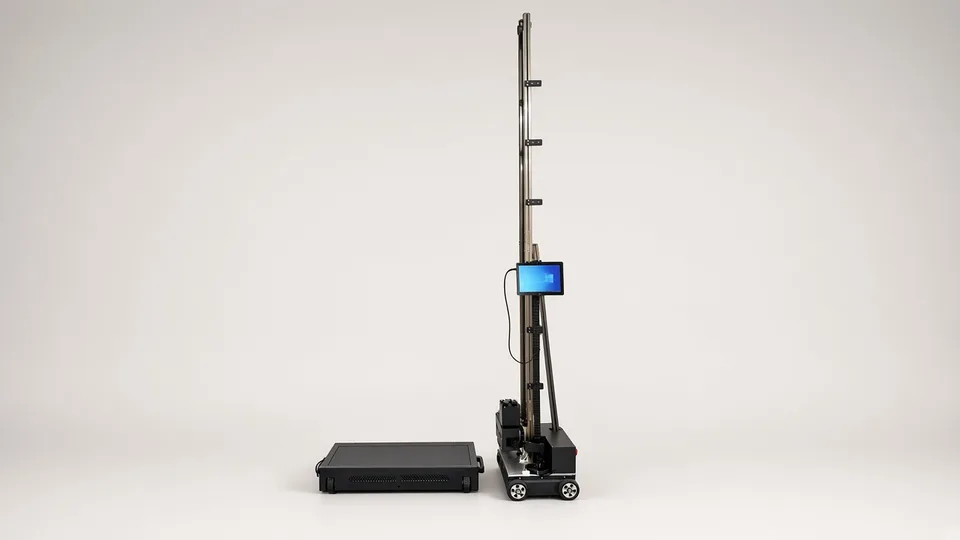
The frame stands taller than the height it prints, because the head needs travel. A room that fits the print may not fit the machine. Ask the frame height at full extension.
3D, 5D and 6D in a title describe shading in the artwork, not the machine. What matters is a licensed control program that runs on a normal laptop and splits a large image into strips with overlap you set.
02
Send these with the enquiry. Without them, any number a factory gives you is a guess dressed as a quotation.
03
| Require this | A pass looks like |
|---|---|
| Print your own image, three strips wide and near full height, on painted plasterboard in the mode you will sell. | From two metres no seam shows, colours match across the image, and one strip takes the time the listed speed implies. |
| Cross-cut adhesion test to ISO 2409 on the print after the stated curing time, filmed, on your primer. | Classification 0 or 1: at most small flakes at the cut crossings. |
| Print across a step or bulge, such as a panel joint or pipe cover. | The head keeps its gap without striking the wall, and the image over the uneven part shows no smear. |
| Pause mid-strip for ten minutes and resume, then repeat after a full power-off. | The print continues on the same line with no band and no nozzle dropout. |
04
05
Print wallpaper or vinyl on a large-format printer and hang it. Deep texture defeats the distance sensor.
Buy a wall-and-floor printer built for both surfaces.
06
We name the kind of source, how many and when, and never the factory. Listed prices are asking prices, not landed cost. Where we do not hold a fact we say so: that is a GAP, not an estimate.
07
Every machine we source in this area is on the Printing & signage page. How a project runs, stage by stage, is on how it works, and what it costs is on pricing.
Straight answers
Most wall printers are built in China, including many sold under European names. A European reseller adds training, local heads and ink, and a site visit. Buy direct if you can service heads yourself; pay the reseller if an idle day costs you a client.
Seams on a multi-strip print, strip time in your selling mode, ISO 2409 adhesion, the distance sensor on an uneven panel, head serial photos, frame height, rail sections, software licence, ink safety data sheets and a spare head.
A Declaration of Conformity citing the machinery law in force on the delivery date, low voltage and EMC, backed by a technical file. A laser line needs EN 60825-1 data; a UV lamp needs EN 62471 data. A CE logo in a listing is only a claim.
Fix ink, head and height, check the documents, then ship the printer with its first ink and the safety data sheets. Add freight, duty and VAT to the listed asking price, and register for WEEE.
The EU business that first places the printer on the market, usually you when buying direct. You check the declaration and technical file exist, keep them, put your name and address on the machine or papers, and act if it proves unsafe.
Contact
Send a machine, a quotation you want checked, or a question. We reply with what we would look at first.
Sent
A person reads every message. You will hear back within one working day.
Not sent
Please email info@nodramachina.com directly and we will pick it up from there.