Printhead model, count and origin
Listings offer two or four heads, often as i3200 or 4720 in one line. They are not the same part at the same price. Ask the exact head model, whether new, and for photos of the head serial labels before shipping.
 No Drama
Buyer guide · Printing & signage
Two 60 cm DTF printers with the same headline can differ in almost everything that decides running cost, and the one-year warranty in the offer may exclude the printheads and the ink system, which are the parts that fail.
01
Listings offer two or four heads, often as i3200 or 4720 in one line. They are not the same part at the same price. Ask the exact head model, whether new, and for photos of the head serial labels before shipping.
All six machine listings we checked stated one year, and one excluded the print head and ink system in writing. Ask for the exclusions list as a document, not a chat reply.
White ink settles. A machine without circulation clogs its white channels after a weekend off. Ask how it circulates, whether it runs while the power is off, and how long it may stand idle.
Four listings named the same RIP package; none stated whether the copy was licensed or who issues the key. Ask for the licence certificate, whether it is tied to one PC, and what a replacement key costs.
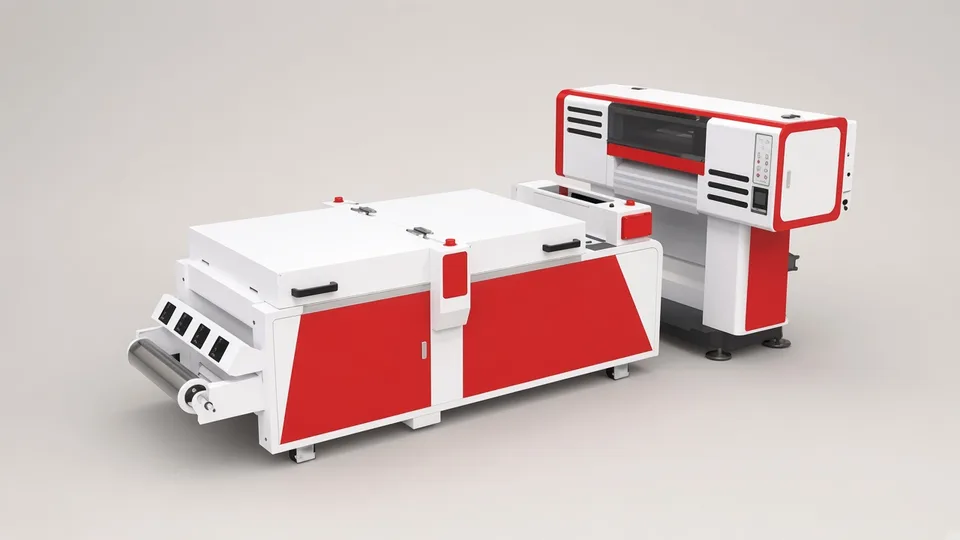
Most 60 cm offers bundle a powder shaker and dryer. Compare heater power, fume extraction and filter, and whether the shaker keeps pace with the printer at production speed.
Speed is quoted per pass mode, and listings rarely say which mode their headline figure uses. The mode you actually sell at decides output. See the arithmetic below.
Some sellers tie the warranty to their own ink. Ask whether third-party ink voids it, and for the ink's safety data sheet before you order.
02
Send these with the enquiry. Without them, any number a factory gives you is a guess dressed as a quotation.
03
| Require this | A pass looks like |
|---|---|
| Print your own file, with a full-colour area, a large white flood and fine text, on film, at the pass mode you plan to sell, on live video with a timer. | Measured metres per hour match the figure in the offer for that mode, not for a lower mode. |
| Stop the printer for two hours mid-job, then restart without a head clean. | A nozzle check prints complete in every channel, white included. |
| Press the transfer onto your fabric, then wash it at the temperature your customers will use, five times. | No cracking or edge lift, colour within what you accept; photos before and after. |
| Photograph the head serial labels and the RIP licence screen. | Head model and count match the invoice; the RIP shows a licensed copy in a named company's name. |
04
05
An automatic screen printing press.
A UV DTF printer or a UV flatbed printer. Textile DTF transfers need heat pressing onto fabric.
Buy transfers from a DTF service, or a small DTG printer if you print only on cotton.
06
We name the kind of source, how many and when, and never the factory. Listed prices are asking prices, not landed cost. Where we do not hold a fact we say so: that is a GAP, not an estimate.
07
Every machine we source in this area is on the Printing & signage page. How a project runs, stage by stage, is on how it works, and what it costs is on pricing.
Straight answers
Many European-sold DTF printers are Chinese frames with a European ink, RIP bundle and service contract. The European price buys local head replacement, a RIP licence handled by the seller, and someone to visit when white clogs. Buying direct saves that margin and moves those jobs to you.
The four tests above, plus: every channel prints a complete nozzle check, white circulation runs, the capping station seals, the shaker heater reaches temperature, and the extraction fan and filter are fitted.
Whether they build the frame and board or assemble bought kits, where heads come from and whether new, whether each printer runs a timed print test before packing, and whether they supply ICC profiles for the ink they ship.
A Declaration of Conformity naming the directives above, a technical file the manufacturer can produce, a CE mark on the machine itself, and a manual in your language. A CE mark on a brochure proves nothing.
If you buy direct from China, you are. You check the documentation exists, put your name and address on the machine or its papers, and keep the declaration for the authorities.
Contact
Send a machine, a quotation you want checked, or a question. We reply with what we would look at first.
Sent
A person reads every message. You will hear back within one working day.
Not sent
Please email info@nodramachina.com directly and we will pick it up from there.