Pouch pick-up and opening
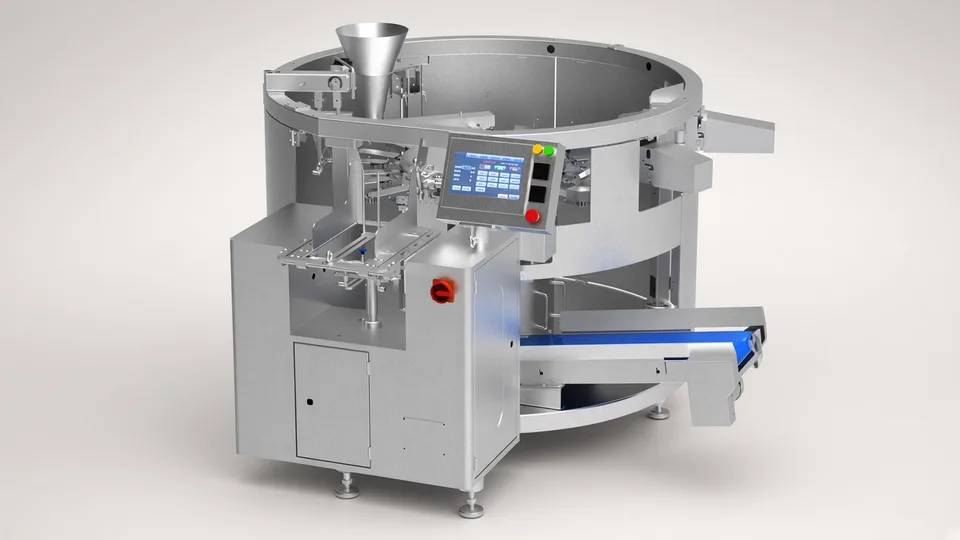
The machine takes each empty pouch from a magazine, grips it and opens it with suction cups and air. Zip pouches need a zip-opening step. Ask how a pouch that failed to open is detected, and whether it is rejected unfilled.
 No Drama
Buyer guide · Packaging
A rotary pouch packer is only as good as its grip on your converter's pouches, and most machines that disappoint do so because pouches from a new print run will not open, not because the sealer is weak.
01
The machine takes each empty pouch from a magazine, grips it and opens it with suction cups and air. Zip pouches need a zip-opening step. Ask how a pouch that failed to open is detected, and whether it is rejected unfilled.
On better frames one handwheel or a servo moves all gripper pairs together. On cheaper frames each station is set by hand. Ask for the full width-change time, including resetting the opening step.
Eight stations is common: pick, date code, open, fill, second fill or settle, hot seal, cool seal, discharge. Ask for the station map. A spare station matters if you later add nitrogen flush or a second filler.
The doser on top, a multihead weigher, auger, piston pump or cup filler, may or may not be in the price. Ask whether filler and turntable are tested together at the factory.
The bottom gusset and the zip make the seal area uneven. Ask for jaw pattern, temperature control per jaw, and whether a cooling bar follows the hot seal.
A cam-driven turntable is robust and fixes the motion profile. Servo index lets you soften the rotation for liquids that splash. Ask which axes are servo.
Stainless grade of contact parts, gripper material, and whether the table can be washed down.
02
Many rotary models are written as stations, then the widest pouch the grippers take in millimetres: 8-200 means eight stations and pouches up to about 200 mm wide. Letters in front are the builder's series mark.
03
Send these with the enquiry. Without them, any number a factory gives you is a guess dressed as a quotation.
04
| Require this | A pass looks like |
|---|---|
| Run a counted batch agreed in advance with your own converter's pouches, including one box from another print run, at target speed on your largest fill. | Failed pick-ups and failed openings stay under the number written in the contract, and each failed pouch is rejected empty with no product spilled on the table. |
| Seal-test a sample from that batch across the zip and across the bottom gusset corners, then squeeze or vacuum-test for leaks. | No leaks, no product in the seal, and seal strength at or above the minimum your pouch converter states for that laminate. |
| Feed pouches with a mouth taped shut, then time one width change from your smallest to your largest pouch. | The taped pouches are detected and rejected unfilled, and the width change is complete within the time written in the quotation. |
05
06
A VFFS packaging machine, which forms bags from roll film and avoids paying a converter for every pouch.
A spout pouch filling machine, built to fill through the spout and fit the cap.
A semi-automatic filler with a band sealer. Rotary changeover time can cost more than the labour it saves.
07
We name the kind of source, how many and when, and never the factory. Listed prices are asking prices, not landed cost. Where we do not hold a fact we say so: that is a GAP, not an estimate.
08
Every machine we source in this area is on the Packaging page. How a project runs, stage by stage, is on how it works, and what it costs is on pricing.
Straight answers
The one that picks, opens and seals your converter's pouches at the speed your fill really allows. Choose frame width from your widest pouch, and speed from the fill time using the arithmetic above.
Rotary designs are similar. Differences sit in gripper adjustment, servo index, jaw temperature control, washdown and the spares network. Keep suction cups, heaters and one gripper set in stock. A used European machine can be the better buy if its width range fits.
The counted batch with your pouches, seal and leak tests over zip and gusset, the taped-mouth reject test, a timed width change, and filler and turntable run together. Then nameplates, guards, emergency stops and the program backup.
A Declaration of Conformity and technical file for the machine, plus food-contact declarations under Regulation (EC) 1935/2004 for every contact part. If the filler comes from another maker, the combined assembly needs its own conformity assessment. Ask for the documents before a deposit.
The buyer, when buying directly from outside the EU. Your name and address go on the machine or its papers, and you confirm the conformity documents exist and match it. For delivery after 19 January 2027, Regulation (EU) 2023/1230 applies.
Contact
Send a machine, a quotation you want checked, or a question. We reply with what we would look at first.
Sent
A person reads every message. You will hear back within one working day.
Not sent
Please email info@nodramachina.com directly and we will pick it up from there.