Industrial sourcing · China to Europe
Buyer-firstOpen route · visible proof

Buyer guide · Food & candy

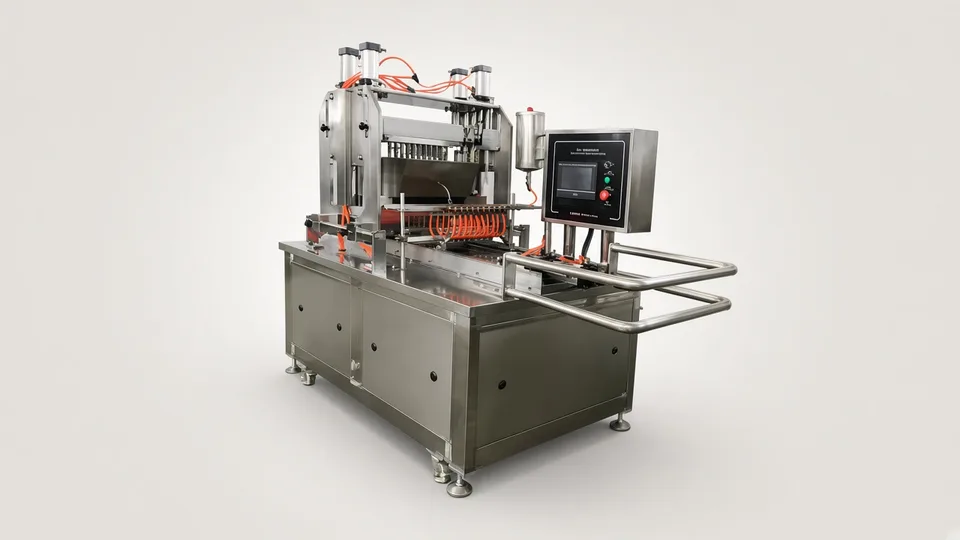
Gummy making machine from China

Gummy making machine covers everything from a bench depositor to a starch mogul plant, and the kilograms per hour in a quote is usually measured at the largest piece on an easy recipe, so the line may never make your gummy at the rate you paid for.

Written and listings checked 30 September 2026. Every figure on this page names its source.

Gummy making machine

01

What you are actually comparing.

Two quotes, one machine name

What hides inside the price
01

Starchless moulds or starch mogul

Most Chinese lines deposit into fixed silicone or coated aluminium moulds and eject the pieces. A starch mogul deposits into starch trays and needs a stoving room and dust control, at a far higher listed price. Decide which process your recipe needs first.

02

Cooker: batch kettle or continuous

A jacketed vacuum kettle suits small batches and frequent recipe changes. A continuous cooker holds solids steadier over a shift. Ask whether final Brix is measured and recorded, or read by hand with a refractometer.

03

Depositor pump and head

Cam pistons are cheaper and set mechanically. Servo pistons change piece weight on the screen and hold it. Ask nozzles per row, whether the hopper is jacketed, and whether nozzles have suck-back to stop tails.

04

Inline dosing of acid, colour and actives

Pectin sets when acid meets it, so acid goes in just before the hopper; heat-sensitive vitamins too. Count the dosing pumps and ask whether each is metered by flow meter or fixed pump speed.

05

Mould material, cavity count and ownership

Silicone releases well but wears; coated aluminium lasts longer but the coating can lift. Ask cavities per plate, plates in circulation, the price of a spare set, and who owns the mould drawings.

06

Cooling tunnel against your hall

Gummies must set before demoulding. Specification tables assume a cool, dry room. If your hall is warmer in summer, the refrigeration quoted may be too small and a longer tunnel changes the footprint.

07

Contact steel and cleaning

Listings usually state SUS304. Acidic pectin syrup and cleaning chemicals may justify 316L on hopper, manifold and nozzles. Ask whether the head strips without tools and the cooker has a CIP connection.

02

Decode the model code.

Chinese depositing lines are often named GD, GDQ or GDT plus a number, usually read as kilograms an hour. Treat it as a family name: one listing showed GDQ150 and GDQ300 at 50 to 100 and 80 to 150 kg/h. Rebuild output from strokes, cavities and your piece weight.

  • 300 kg/h at 4 g a piece is 300,000 / 4 = 75,000 gummies an hour.
  • 30 strokes a minute is 30 x 60 = 1,800 strokes an hour, so 75,000 / 1,800 = about 42 cavities must fill every stroke.
  • The same line making 2 g gummies gives half the kilograms: about 150 kg/h.

03

Before you ask for a price.

Send these with the enquiry. Without them, any number a factory gives you is a guess dressed as a quotation.

04

Turn the claim into a demonstration.

Require thisA pass looks like
Cook and deposit your own recipe at the offered stroke rate. Weigh a counted sample of single pieces across the full mould row, early and late in the run.Every piece inside your weight tolerance, outer nozzles matching the centre ones.
Run at least one full hopper cycle and watch the nozzles.No tails, strings or drips, and no tip build-up that forces a stop.
Demould the whole run and count rejects.Broken, misshapen or stuck pieces are counted in the FAT record and inside the contract limit.
For supplement gummies, send start, middle and end samples to a laboratory for active content.Assay inside label tolerance at all three points, report attached to the FAT record.

05

The documents that must arrive with it.

The one people forget. The mould drawings and the silicone food contact declaration. Without drawings every new mould comes from the original factory; without the declaration an auditor can stop the moulds being used.

06

When this is the wrong machine.

Buy something else if

Named, not hedged
01

You are testing a recipe or making a few thousand trial pieces a day.

A tabletop gummy depositor with a separate kettle. Fix the recipe before you size a line.

02

Your product is a jelly bean, a very high-solids chew or a shape that cannot release from a rigid mould.

A starch mogul plant, new or used European, rather than forcing a mould line.

03

Your recipe gels in the hopper, will not set in the tunnel, or sticks in the sample run.

A confectionery technologist first. A dearer line will not rescue a recipe that does not deposit.

07

Where the numbers come from.

We name the kind of source, how many and when, and never the factory. Listed prices are asking prices, not landed cost. Where we do not hold a fact we say so: that is a GAP, not an estimate.

08

Related machines.

Every machine we source in this area is on the Food & candy page. How a project runs, stage by stage, is on how it works, and what it costs is on pricing.

Straight answers

Questions buyers ask about this machine.

Chinese vs European gummy making machine: what is the real difference?+

The process is the same. The difference is depositor precision, recorded recipe control, cleaning design and parts supply. For confectionery a Chinese mould line can be enough. For a supplement gummy, test weight spread and assay first, and price a used European depositor alongside.

What should a gummy making machine inspection checklist include?+

Serial numbers against the declaration, contact steel grade, silicone declaration, nozzles and cavities against the offer, guard interlocks at demoulding, your recipe run with weights recorded, and a timed clean-down.

What should a gummy making machine factory audit look at?+

Whether they make depositor heads and moulds in house, and whether their test line can run a pectin recipe, which is harder than gelatin.

What CE documentation comes with a gummy making machine?+

A Declaration of Conformity under the Machinery Directive 2006/42/EC up to 19 January 2027, and the Machinery Regulation (EU) 2023/1230 from 20 January 2027, plus 2014/35/EU and 2014/30/EU. A CE mark on a brochure proves nothing.

Who is the EU importer of a gummy line, and what do they carry?+

The company placing it on the EU market. Its name and address go on the machine or documents, and it checks the conformity documentation. Buying direct, that is you.

Does a supplement gummy line need pharma GMP?+

Supplements are food law, so contact materials follow Regulation (EC) 1935/2004. EU GMP (EudraLex Volume 4) applies only to licensed medicine makers.

Contact

Tell us what you need.

Send a machine, a quotation you want checked, or a question. We reply with what we would look at first.

A person reads it. No marketing automation. Based in the Netherlands.