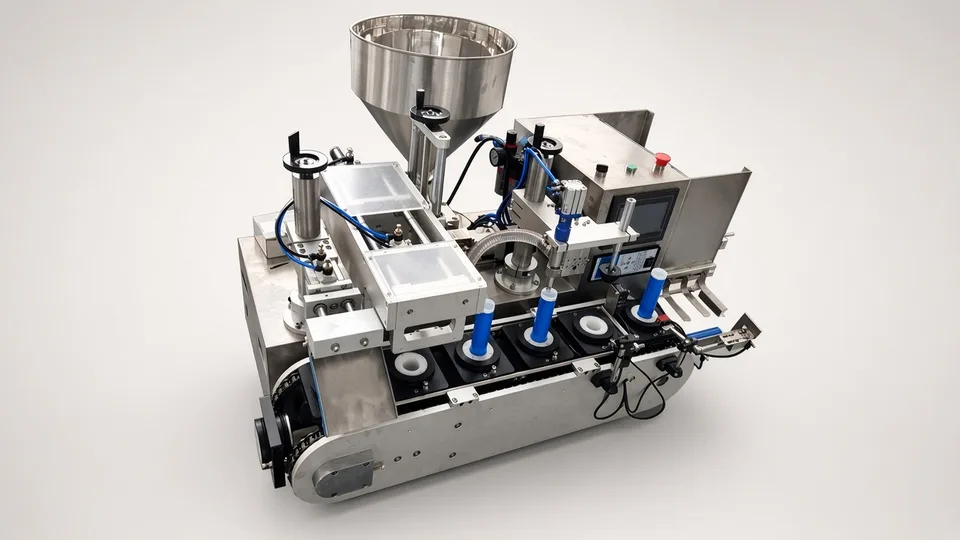
01Sealing head and your tube wall
Hot air melts the inner layer of a plastic or laminate tube and jaws press it shut. Ultrasonic sealing welds with vibration and is often chosen for thin or recycled walls. A quote that says only 'sealing' tells you nothing: ask which head is fitted and whether it was set up on a tube like yours.
02Fill accuracy on a cream, not on water
Accuracy figures are usually measured with water. A thick sunscreen traps air, so the piston delivers less than its stroke. Ask for accuracy on your product at your speed.
03Clean seal zone
Cream left on the inside of the tube end stops the seal forming. Ask whether the nozzle dives into the tube and fills bottom up, and whether it has a cut-off valve so it does not drip on the way out.
04Eye mark and printed artwork
A sensor turns each tube until its print mark faces front before sealing. Glossy, metallic or dark tubes can defeat the sensor. Send printed tubes, not blanks.
05Tube holders per diameter
Each diameter needs its own holders and often its own sealing jaw. Ask how many diameters the price covers.